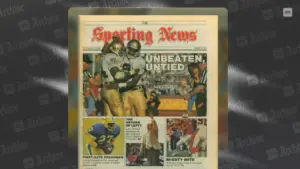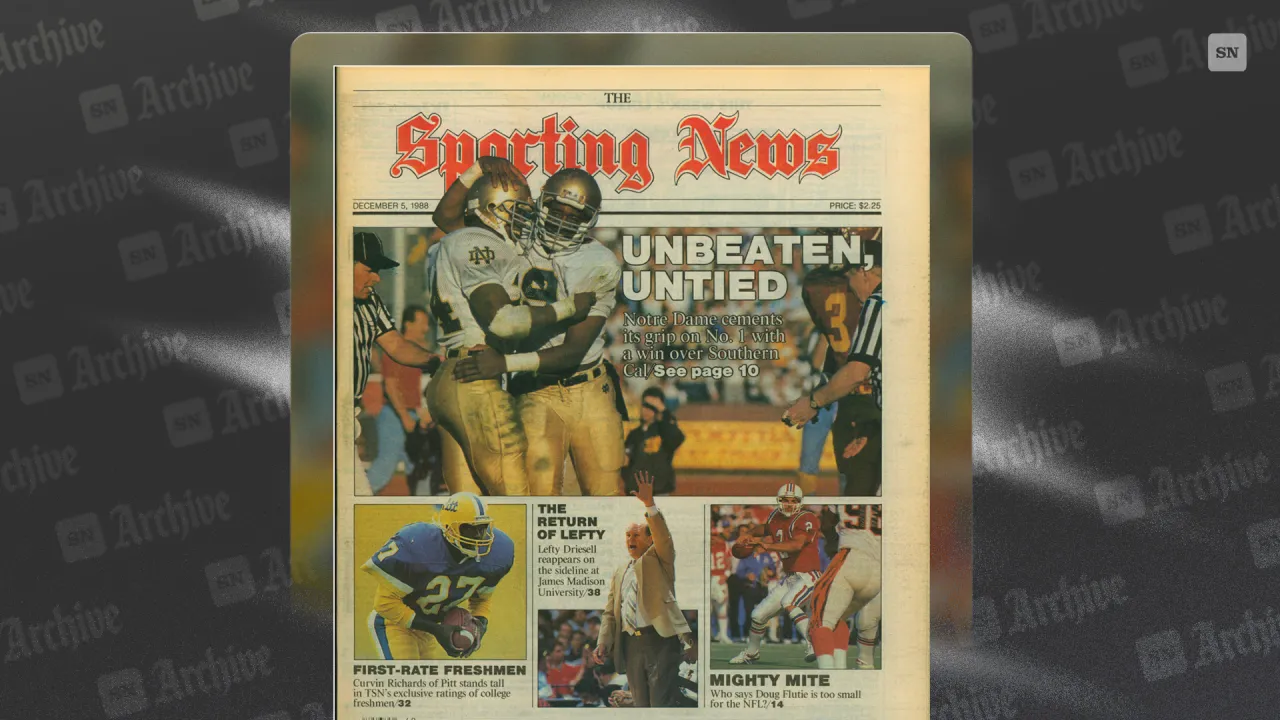
This article. “Notre Dame gets its Irish up” by Richard Hoffer, originally appeared in the October 24, 1988 issue of The Sporting News.
SOUTH BEND, Ind. — The Fighting Irish of Notre Dame proved worthy of tradition and even their name when they battled from pregame to sundown October 15 in a 31-30 upset of top-ranked Miami (Fla.) that ended the Hurricanes’ 36-game winning streak in regular-season play.
This game had it all: Bad feelings and good weather, national championship implications, enough bitterness that one coach was calling for a cooling-off period and a controversial big play—a fumble call on the Notre Dame one-yard line that turned the ball over to Notre Dame with 3:52 left, and Miami still doesn’t know why.
Miami quarterback Steve Walsh set records against Notre Dame for most pass completions (31) and most yards passing (424) while tying a record for most touchdown passes (4). But he also suffered three interceptions, one of which safety Pat Terrell returned 60 yards for a touchdown that gave the Irish a 21-7 lead in the second quarter.
SN ARCHIVES: Access every SN issue since 1886, for free
Notre Dame quarterback Tony Rice, who seldom passes, threw for 195 yards. He fired one touchdown pass and set up two other scores with bombs of 44 and 57 yards.
And to bracket the excitement, there was a pregame fracas and a last-minute defensive stand by Notre Dame as Miami went for a two-point conversion in an attempt to win the game in the last 45 seconds.
Picture the Notre Dame players holding hands on the sideline as Walsh vainly searched for a receiver and finally lobbed the ball in the direction of tailback Leonard Conley, only to see Terrell bat away the pass.
After the game, Notre Dame Coach Lou Holtz expressed concern about the growing hatred in this rivalry when he said, “I think the two schools really and truly need to talk about playing in the future. I am talking about next year. I think we need a cooling-down period.”
Notre Dame is to play at Miami in 1989 and the series returns to South Bend in 1990. But things have been hot since 1985, when Miami was still passing the ball at the end of the game in giving former Irish coach Gerry Faust a 58-7 sendoff.
The undefeated Irish (6-0) came out of this game having avenged four straight losses to Miami and with a chance at the 1988 national championship. That possibility probably hinges on a November 26 game at Southern California. Just as important, the Irish have risen out of a sea of mediocrity and once again seem worthy of the Notre Dame tradition.
MORE: Revisiting infamous 1988 Notre Dame vs. Miami game
And yet, people can argue, Notre Dame may not have proven it’s a better team than Miami. The Hurricanes, after all, outgained the Irish, 481 yards to 331. If Miami hadn’t had seven turnovers, it probably would have been the winner.
Yet these things seem to happen all too often in Notre Dame Stadium.
On a day that was a tailgater’s heaven, the Irish and Hurricanes brawled before the opening kick-off. No wonder, because there had been bad blood all week in South Bend, where T-shirts that proclaimed “Catholics vs. Convicts” were a popular item. On top of that, the Notre Dame dining halls had stopped serving whole oranges two weeks before the game, fearing that some students would save the oranges to throw at the Miami team.
Apparently, as Notre Dame remained on the field to practice punts, some Miami players ran through the Irish on the way back to the dressing room for pregame instructions. What happened after that is open to interpretation.

“We were attacked,” sniffed Miami Coach Jimmy Johnson.
Notre Dame safety George Streeter countered by saying, “If we were not provoked, then we were incited.” Streeter continued, “This is our house, South Bend, not Somewhere, Florida. They come here and try to bully us. That’s the tactic of national champions. They don’t expect you to be there.”
Irish teammate Corny Southall chimed in: “We all knew something was gonna happen and we weren’t gonna let it slide.”
Probably, Notre Dame’s readiness was larger than Miami’s provocation. You could tell by the way Holtz tried to downplay the incident (“Our players were excited,” he said) and Johnson did not.
“Not only did I think they (Miami) are the best football players in the country,” Johnson said, “I told them they are the classiest team in the country.”
Certainly, Miami has long since lived down its reputation as “convicts.” As far as truth in labeling goes, Miami may even be more Catholic than Notre Dame. Seven offensive starters for the Hurricanes, including Walsh, are Catholic.
There were other bones of contention on this afternoon, though. Principal among them was a play by Miami fullback Cleveland Gary, who caught a game-high 11 passes but will be remembered for a fumble, a hotly contested one, at Notre Dame’s one-yard line.
MORE: Get to Know the Michigan-Loving Family of Notre Dame QB CJ Carr
Trailing, 31-24, Miami drove to the Notre Dame 11 and Walsh hit Gary on a fourth-down pass at the one. As Gary hit the ground at the goal line, he lost control and the ball was recovered by Notre Dame linebacker Michael Stonebreaker.
Miami is still confused about that play. The officials ruled it a catch and a fumble. But Johnson said the officials told him it was a dead ball and that Miami had turned it over on downs.
Gary, for his part, said it was a touchdown. “If I cross the plane and then it squirts out, is it a touchdown?” he asked. “OK. Next thing I know, their offense is lining up across from us.”
Miami stuffed Notre Dame and got the ball back at the 14, in time to score its final touchdown—on an 11-yard pass from Walsh to Andre Brown on fourth down. But by then, the Hurricanes had lost time—if not a touchdown.
“We may have gotten the short end of the stick on that decision,” shrugged Walsh.
“We had the ball on the one and it got turned around,” said Johnson, “which is something I don’t understand.”
MORE: Ranking the best Miami players of all time, from Ed Reed to Ray Lewis and beyond.
Johnson and Walsh agreed, however, that the game shouldn’t have come down to that one play—or the two-point conversion attempt. “We made too many mistakes,” Johnson said.
There was, in addition to all the turnovers, a Miami fake punt that didn’t work and gave the ball to Notre Dame for a quick seven points in the third quarter, boosting the Irish into a 28-21 lead.
There were more traditional mistakes, of course. In the second quarter, defensive end Frank Stams tipped a Walsh pass to Terrell, who ran it back for a touchdown. And “Notre Dame’s last score, a 27-yard field goal by Reggie Ho came after Irish defensive tackle Jeff Aim simply stood up and intercepted a Walsh pass to snuff a Miami drive.
As debilitating as those mistakes were, Miami managed to play on.
In the final 2.5 minutes of the first half, after Notre Dame had led 21-7, Walsh threw scoring passes to Conley and Gary to produce a 21-21 tie.
Miami’s final touchdown came after linebacker Randy Shannon had stripped the ball from Rice at the Notre Dame 14.
There was that kind of heroic play from both sides all afternoon. But it all seemed to boil down to a couple of, well, incidents. This was an emotional game, no question. Holtz tried to downplay Notre Dame’s recent humiliations, telling his team this was only a game and not World War II all over again, but Stams, a senior, remembered that 1985 embarrassment in Miami. In an unguarded moment, Stams said, “It was a bitter pill to swallow. That game really stuck in my throat. Beating these guys was a goal, ever since that game.”
It may be better to remember the 1988 game from the final dramatic moment than from the first. There was never any doubt that Johnson would direct his team to go for the victory, and not the tie.
“We always play the game to win,” Johnson said.
But Terrell broke up Walsh’s pass as Rice and a whole chain of Irish players held hands on the sideline.
“This was a win by the Notre Dame spirit,” Holtz said afterward.
Sometimes, these things are hard to explain.