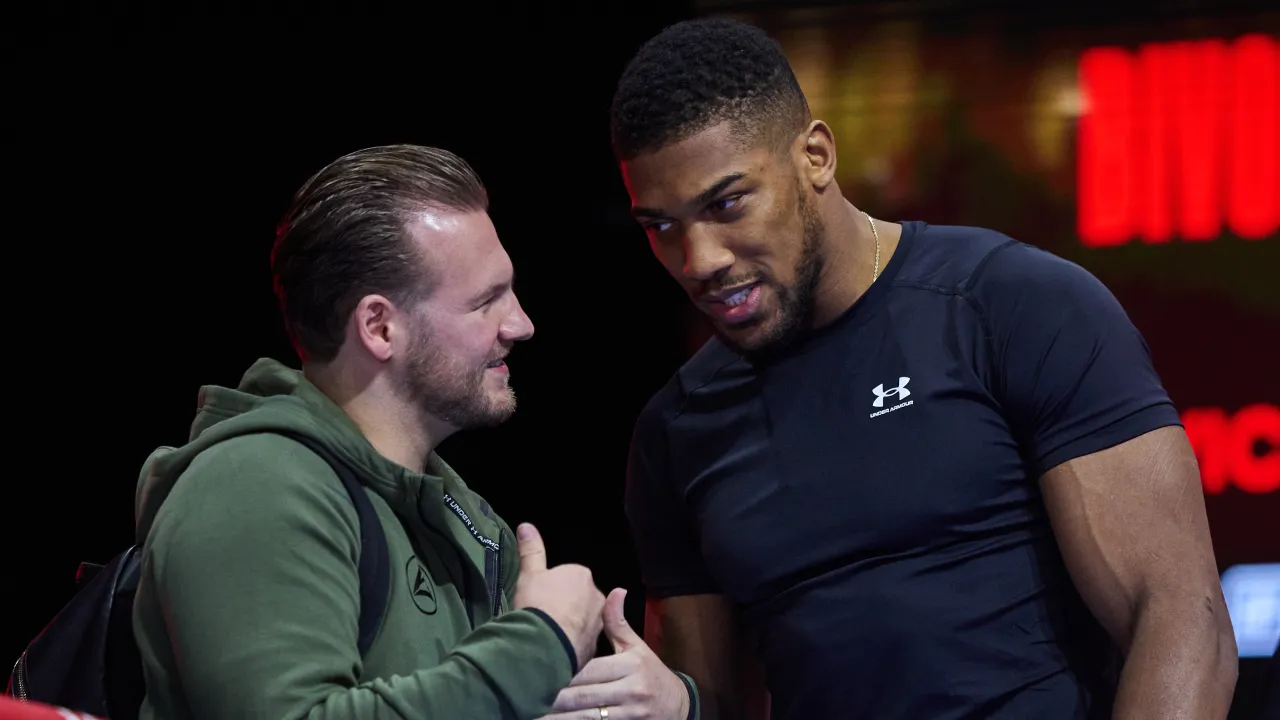
For a fighter who is, largely unfairly, criticised for having a gilded existence in boxing, Anthony Joshua always seems to be searching.
The British star entered professional boxing as a 2012 Olympic gold medalist, won a world title in his 16th fight and is a former two-time unified heavyweight champion.
But for the past seven years, Joshua has made frequent changes to his training setup, employing several esteemed boxing minds to serve as his chief second.
“Every coach has added something unique,” he told The Sporting News earlier this year. “But where I’m at now, the coaches have just got to trust me as well because I’ve been around the block. I have to streamline all that stuff that I’ve learned, and have a relationship with the coach where the coach also has to understand that he can be taught as well.”
He added: “What I’ve learned in my career is to try and work with specialists. If you want to be the best, there’s specialists in every field. There’s people who know what they’re doing and know what they’re talking about; there’s also people that blag what they’re doing and blag what they’re talking about. And there’s also specialists who are the creme de la creme.”
Ahead of his huge and long-awaited showdown with Tyson Fury in Cardiff this Saturday, Joshua once again tweaked his training setup.
MORE: Fury and Joshua are best of enemies in friendly London launch
Who is Anthony Joshua’s coach?
Ben Davison will run Joshua’s corner, beginning a second spell as the 37-year-old’s lead trainer.
Davison famously oversaw Fury’s journey from drug and alcohol abuse, depression and obesity back to the heavyweight elite. Their five bouts together included Fury’s dramatic draw against Deontay Wilder in their initial fight.
The Essex-based trainer worked with former two-weight world champion Billy Joe Saunders around that time and helmed Josh Taylor’s successful bid to become undisputed super lightweight champion against Jose Ramirez in May 2021. Leigh Wood’s against-the-odds run to twice reign as WBA featherweight champion perhaps represents Davison’s best work. He also came in to help steer Fabio Wardley’s unique journey from white-collar novice to heavyweight world champion. American pound-for-pound star Devin Haney also works with Davison and his chief video analyst, Lee Wylie, on a consultancy basis.
Rising British featherweight prospect Shabaz Masoud and recent heavyweight title challenger Moses Itauma are star pupils at the Ben Davison Performance Centre, where assistant coach Barry Smith is also a key part of the setup.

MORE: An in-depth look at Ben Davison’s training methods
Is Ben Davison a good coach?
Davison’s focus on drilling and video analysis, with Wylie a key part of his setup, has come under scrutiny from proponents of boxing’s “old school”. But the roll call of high-calibre boxers who continue to work with him despite high-profile recent setbacks speaks volumes. Those fighters are not with Davison as some sort of charity case.
“The whole point of the way we do things is you get a plan, you study it, you drill the scenarios. So by the time you get in there, you haven’t got to overthink it,” Davison explained in a 2023 interview with The Sporting News ahead of Wood’s dramatic KO win over domestic rival Josh Warrington.
“If you’ve done the work beforehand, when you get in there it becomes instinct rather than having to think in the moment. People might say, ‘Oh, you’re over-complicating by doing things like that…’, you actually don’t. You’re actually doing the complete opposite.
“By trying to work it out in the moment, how many different variables are there that might happen? That is a lot harder — processing what might happen, what he’s going to do, what he’s setting up, etcetera — than to have been through a scouting report, watched plenty of film on the opponent and to have come up with a conclusion that the majority of the time when he does this, you’re looking for that, the majority of the time when you do this, his reaction is going to be that.
“And you drill that to a point where you haven’t got to think about it. It becomes second nature.”
Most of the recent criticism of Davison has centred on his in-fight work when the best-laid plans have gone awry – most notably when Itauma spectacularly ran out of gas during his IBF title fight against Filip Hrgovic, having dominated pretty much every round, and during Wardley’s punishing back-to-back losses to Dubois. It should be noted that both Itauma and Wardley remained with Davison despite their setbacks, and Joshua must be convinced that Davison’s poor run of heavyweight form will turn around on November 11.

Queensberry
Anthony Joshua trainer history: How many coaches has AJ had in boxing career?
Davison was the fifth of six men to have operated as Joshua’s chief second across 34 professional fights. But there’s a little more to it than that.
Rob McCracken
The man who helmed the majority of Joshua’s career as both an amateur and a professional. McCracken, who trained former two-time super middleweight world champion and current outspoken Joshua sceptic Carl Froch, is the performance director at GB Boxing.
His role at the head of the UK’s decorated amateur setup meant he guided Joshua to Olympic gold in 2012. The pair continued to work together when the new national hero turned professional.
Joshua still did plenty of his training with the GB squad at the English Institute of Sport in Sheffield, but McCracken’s job with the national setup prevented him from running Joshua’s corner on fight nights. That task fell to experienced trainer Tony Sims, most recently noted for his impressive work with Conor Benn.
Sims was in Joshua’s corner for his first 17 professional fights, including his IBF world title win over Charles Martin. For his second defence against American Eric Molina in December 2016, McCracken assumed control of the corner on fight night after reaching an agreement with Team GB.

He was a calming and measured voice as Joshua came through the first knockdown of his career to thrillingly defeat veteran former champion Wladimir Klitschko at Wembley in 2017. That began a run of headline stadium fights against Carlos Takam, WBO champion Joseph Parker and Alexander Povetkin, all won and all overseen by McCracken.
The 22-0 Joshua travelled to Madison Square Garden to make his U.S. debut against late replacement Andy Ruiz Jr., and the dream swiftly turned into a nightmare. Joshua floored Ruiz but was badly buzzed when going in to close the show in round three. He had been dropped four times by the time the referee waved the action off in round seven.
Angel Fernandez
Although he never took charge of a Joshua corner on fight night, UK-based Spaniard Fernandez became a key part of Team AJ during this phase of his career. McCracken remained after the Ruiz loss, but Joshua bought Fernandez and assistant trainer Joby Clayton into his camp ahead of the rematch to bring a fresh tactical perspective and sharpen up his pad work.
The initial results were impressive as the Briton comfortably outpointed an out-of-shape Ruiz over 12 patient rounds in Saudi Arabia. The new look team saw off Kubrat Pulev in a mandatory defence before former undisputed cruiserweight champion Oleksandr Usyk loomed.
Inexplicably, Joshua went into the ring at Tottenham Hotspur Stadium and tried to outbox the much smaller master boxer. That loss proved to be the end of the road for McCracken, whose authority had started to feel diluted. Clayton left too, but Fernandez remained to work alongside the next head coach.
Robert Garcia
Joshua went through trial spells with a handful of elite trainers, including Eddie Reynoso and Virgil Hunter, before plumping for highly respected Californian Garcia, who is now a three-time American Boxing Writers Association Trainer of the Year.
Alongside Fernandez, Garcia oversaw a much-improved and more aggressive performance in the Usyk rematch, which the champion won via split decision after a decisively brilliant showing during the championship rounds.
That proved to be Joshua and Garcia’s only fight together, and he stands apart among the heavyweight’s former trainers in having spoken negatively about his experience.

“When I first got to training camp in England, the first week, there was things that they were doing, people involved; it’s just not my style,” he told the Little Giant Boxing podcast. “And honestly, I have all the emails where I told the management team, I said, ‘Please fly me home.’ It was a joke.
“They convinced me to stay, change things around, which I did – I changed things around and we ended up doing good. But one week into camp I was ready to leave, so if that was the case [that they weren’t happy with me] they should have sent me home when I wanted to go.”
Speaking to Boxing Scene, Garcia revealed he declined to take part in a forthcoming Netflix documentary about Joshua because he didn’t want to “lie”, although he praised the Englishman as “a great person”.
Derrick James
Joshua ripped things up more radically after the second Usyk loss and relocated to Dallas to train under Errol Spence’s mentor Derrick James.
Ahead of a planned bout with Dillian Whyte, which fell through when his long-time rival failed a pre-fight drug test, Joshua said he expected to be with James until the end of his career. Despite a showreel KO in the latter fight, his wins over Jermaine Franklin and Robert Helenius during this period were unremarkable.
A radical change in the boxing landscape then forced another change to Joshua’s training plans. He was booked to face his one-time amateur foe Otto Wallin on the “Day of Judgement” card, which marked Riyadh Season’s first major move into sport. James was unavailable to oversee a camp in Texas for the hastily arranged December date.
Ben Davison
Joshua had been ticking over at Davison’s gym and decided to lock in that arrangement for the Wallin fight. The initial results were very impressive as AJ meted out a one-sided beatdown on Wallin, producing his most authoritative performance since losing to Ruiz.
Turki Alalshikh’s plan was to pit Joshua against Deontay Wilder, only for the American knockout artist to lose over 12 rounds to Joseph Parker on the Riyadh card. Former UFC heavyweight champion Francis Ngannou was given the gig instead, after he came close to scoring a stunning upset over Fury in October 2023.
Davison’s strategy leaned into Joshua’s fearsome power against a boxing novice and Ngannou was twice floored before being rendered unconscious in round two.
Joshua appeared to be on the crest of a wave once more, only for all the enthusiasm over his union with Davison to go up in smoke when he was battered to defeat inside five rounds by Daniel Dubois at Wembley.

Iegor Golub
Joshua spent more than a year out of the ring after losing to Dubois in September 2024, partly due to injury. When he returned for a money-spinning bout with YouTube star Jake Paul in Florida, he did so with the brains behind a former conqueror in his corner.
AJ moved his camp to Valencia, Spain, to work with Usyk’s training team. The Ukrainians operate a collaborative approach under camp manager Serhii Lapin, with Usyk’s former amateur teammate Golub running the corner on fight night.
“They all come from an Olympic background. If you look at it, most successful professionals have successful amateur careers, but then sometimes when you turn over from amateur into professional, there’s such a difference with the approach,” Joshua told The Sporting News. “But ultimately, they go hand in hand, I think.
“So if you can take that same amateur setup and then move it over to a professional environment where you have a masseuse, you have a chef… it’s done properly. [Team Usyk] want you to win a championship. It’s not just by hard work or luck; they have a proper team.
“He’s the top of the division. He’s beat me, he’s beat Dubois, he’s beat Fury. What the f— are they doing? I need to figure this out myself. I was scratching my head like, ‘How?’ But I can see it now. It’s not based on luck.”
There was little to glean from the spectacle of Joshua chasing Paul around the ring before breaking his jaw in three places, with the main benefit being a chance to groove things with his new training team. Shortly after the Paul bout, Joshua was plunged into an unimaginable tragedy.
He suffered injuries as a passenger in a fatal car accident that killed his team members and close friends Sina Ghami and Latif Ayodele. Amid doubts over whether Joshua would box again, he returned to camp with Usyk, taking solace in the structure and routine, along with “a friendship based on duty to one another”.
The anguish of a caring friend was painted across Usyk’s face when Joshua was floored twice in the first round of his comeback fight against Kristian Prenga in July. A spectacular KO to close the show and save the Fury fight averted a sporting calamity. In crisis at the end of round one, the language barrier between Joshua and Golub did not seem ideal.
Speaking in September after Pat Brown’s British cruiserweight title win over John Hedges, Eddie Hearn said he expected Joshua’s relationship with Team Usyk to continue “in some capacity”, but gave pointed praise to Davison after footage emerged of Fury’s former coach and pending opponent working together again
“Even when Ben wasn’t his principal trainer, he was working with him strategically, talking all the time. I think he respects Ben a lot. There’s probably a feeling that Ben Davison knows Tyson Fury extremely well. For me, I think he’s one of the best trainers in the world.”