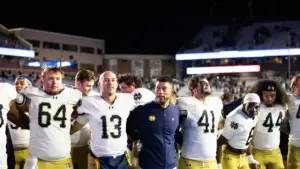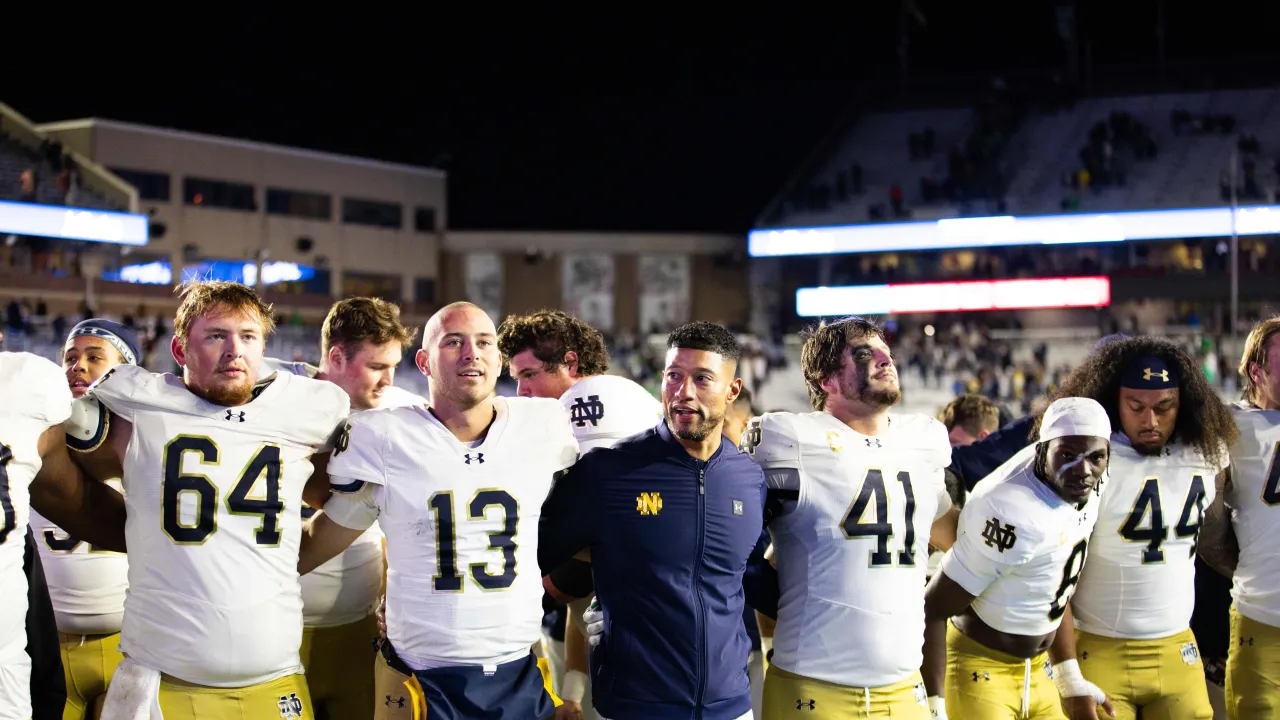
Notre Dame football is a program steeped in tradition.
From “Play Like a Champion Today” and “Win One for the Gipper” to dancing leprechauns (and other fantastical figures), the Fighting Irish are arguably college football’s signature brand.
And like any cultural entity worth a damn, the Irish have their own gesture to proclaim their hegemony in the sporting landscape.
With that, here’s a look at the history of Notre Dame’s push-up tradition, one of the most eye-catching routines in all of college sports.
MORE: How Miami ruled the 1980s and reveled in Notre Dame rivalry
Why Notre Dame fans do push ups to celebrate touchdowns
The Fighting Irish faithful unleash their inner Jack Lalanne when their beloved side finds pay dirt, tossing willing and able spectators airborne. To the untrained eye, it looks like crowd-surfing, an iconic — but not particularly distinctive — ritual.
Until one notices those disciples lifting themselves up and off the burbling surface. It’s a push-up in the most generous sense, one which has enchanted those of a Notre Dame disposition for about as long as anyone can remember.
“It’s arms and legs going everywhere,” senior Jackson Amorosa told The Athletic. “When you see everyone going up across the student section, it’s such a cool sight.”
The practice doesn’t necessarily carry the same effect as its namesake. Those who bob up-and-down the Notre Dame Stadium concourses are not doing so to supersize their pectorals and sculpt their triceps. Rather, the custom is a holy one welcome to all willing to embrace its rhythms — although stadium ushers have been known to ask practitioners to rein it down on occasion.
“There’s a togetherness to it,” said another senior. “I think it builds community — like us and the team uniting.”
MORE: 5 things to watch in Week 10
A group of roommates are alleged to have started the tradition more than 40 years ago. The origins of the festival of bodies is a little murky, although the general sentiment is that the friends wanted to commemorate new Notre Dame head coach Lou Holtz’s arrival in in 1986 — a step towards relevancy after a dour few years in South Bend.
The move quickly became a hit, taking hold of almost every inch of the Fighting Irish’s colossus. Even the mascot himself, aptly titled the Leprechaun, couldn’t avoid its glare.
“It was a matter of pride for the mascot,” said former Fighting Irish mascot Jamie Glover said. “If you couldn’t do pushups, you would hear it from the students.”
The custom finds life all these years later, breathing color into new generations of Fighting Irish students. Given its popularity, it’s unlikely to fall out of favor any time soon.
MORE NCAAF: