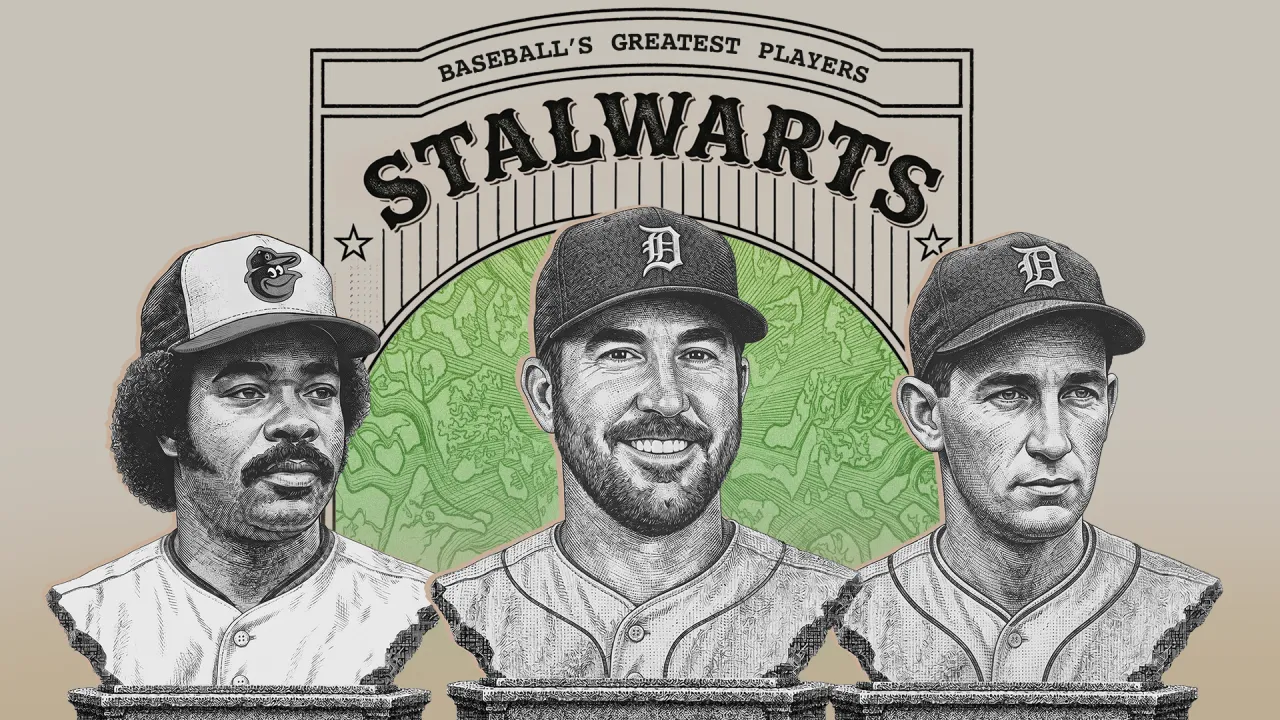
They made excellence routine. Careers defined not by peaks, but by the steadiness and certainty they embodied.
“He’d say hello at the start of spring training and goodbye at the end of the season and the rest of the time he let his bat and glove do all the talking for him.” Ty Cobb offered those remarks about Charlie Gehringer, though it’s a quote that applies to every member in this room.
The latest entry into our SN 140: Baseball’s Greatest Players project features ten legends who achieved greatness through metronomic excellence.
Managers trusted them, teammates leaned on them, and fans identified with them. What set them apart from their peers was not one brilliant season or accomplishment, though they had their fair share of those, but the weight of their dependability.
Each year they would wrap up a strong season, pack up their bags for the winter, and you could be sure they’d be back again the next spring.
These are the Stalwarts.
BASEBALL’S GREATEST PLAYERS
Immortals | Artists | Unicorns | Juggernauts | Supernovas | Unsung | Showmen | What-Ifs | Pioneers | Prodigies
(Editor’s note: Each hyperlinked name takes you to that player’s page within the digitized SN Archive. Once registered (it’s free!), readers have instant access to every article and cover related to each player, as they originally appeared in print.)
Baseball’s Greatest Players: The Stalwarts
Justin Verlander
The quintessential Justin Verlander start was one in which he got all 27 outs and ended with his fastest pitch of the day.
Including the postseason, Verlander recorded five 4,000-pitch seasons, something no other active pitcher has done once.
MORE: Justin Verlander’s heart-warming exit after final MLB start
Smokey Joe Williams
For two-and-a-half decades, “Smokey” Joe Williams overwhelmed hitters with a fastball that aged as gracefully as he did.
Williams posted a 137 ERA+ in his twenties (1907-16), a 148 ERA+ in his thirties (1916-15), and a 152 ERA+ in his forties (1926-32).
Adrian Beltré
A one-year, prove-it contract with Boston at 31 served as the prelude to Adrian Beltré’s improbable prime, which stretched deep into his thirties in Texas.
Beltré led the majors in defensive runs saved in the 15 seasons spanning 2003-17 (201), during which time only Albert Pujols and Miguel Cabrera accumulated more total bases than he did (4,132).
Ryne Sandberg
Ryne Sandberg played baseball the way Chicagoans lived their lives, with a workmanlike resolve that made him an institution.
Sandberg recorded six 100-runs, 500-assist seasons, the second–most in history (Charlie Gehringer: 6).

SN
Paul Molitor
Paul Molitor ignited offenses in Milwaukee, Toronto and Minnesota, finding another gear in his thirties once good health finally matched his talent.
Molitor is one of five players to hit .300 in a 3,000-hit, 500-steal career, and the only one to debut between 1906 (Eddie Collins) and 2001 (Ichiro).
Eddie Murray
Eddie Murray was best appreciated over 162 games, where his mind-numbing consistency made one season indistinguishable from the one before or after.
Murray generated 1,340 RBI from the cleanup spot, second-most since the statistic became official in 1920 (Lou Gehrig: 1,515).
Carlton Fisk
Carlton Fisk is remembered for willing one ball fair, but defined by the tenacity that kept him in the crouch until he was 45.
Fisk is the only catcher to compile 25 WAR on multiple teams (39.5 with Red Sox, 28.9 with White Sox).
Pop Lloyd
The venerable Pop Lloyd was considered Honus Wagner’s equal at shortstop during Black baseball’s formative years, a comparison Wagner himself found flattering.
Lloyd was the oldest player in his league in each of his last four seasons (ages 42-45 in 1926-29), during which he batted .351 as an everyday infielder.
SN Archives (1977): Appreciating Pop Lloyd’s one-of-a-kind origin story
Mule Suttles
For a quarter-century, the unassuming Mule Suttles left teammates and opponents marveling at how far he could hit a baseball.
Suttles’ 10-year gap between 225 OPS+ seasons (1926, 1936) is second-longest in history behind only Ted Williams’ (1941, 1957).
Charlie Gehringer
Aptly nicknamed “The Mechanical Man,” Charlie Gehringer played like a dependable superstar on the field and lived like a choir boy off of it. As detailed in a 1978 Sporting News feature, “Gehringer did everything right.”
In two separate stretches from 1927-31 and 1932-35, Gehringer played in 511 and 504 consecutive games, respectively; he and Pete Rose are the only players with multiple 500-game streaks.
Our process for Baseball’s Greatest Players
Every week through the end of the World Series, we’ll unveil one room at a time — 10 players along with the numbers that define them — culminating in the Inner Circle, the 10 greatest to ever play, period.
We researched and considered over 500 names, weighing not only fundamental changes to the game, but also factoring in modern metrics, recently uncovered Negro Leagues data, shifting league demographics and the evolution of today’s stars. We stripped away preconceptions and applied objective, critical analysis to every player under consideration.
SN140: Baseball’s greatest 25 teams since 1886
Once we landed on 140 names, we decided that traditional rankings simply don’t work for baseball. How is one to honestly assess if Cy Young — a pitcher whose career began in the 19th century — is greater than Albert Pujols, a 21st-century slugger? How do you compare Josh Gibson in the Negro Leagues to Jackie Robinson in the National League?
Instead, we created 14 position-less rooms, each representing and articulating varying archetypes of greatness.
From there, we slotted 10 players into each room with careers connected by defining common threads.
We factored in modern metrics, recognized and utilized now accessible Negro Leagues data, contextualized changing league demographics, considered functional changes to the game such as strike zone and mound height adjustments, and included active players alongside their historical counterparts.
The result?
The most unique, comprehensive and celebratory evaluation to date of Baseball’s Greatest Players.