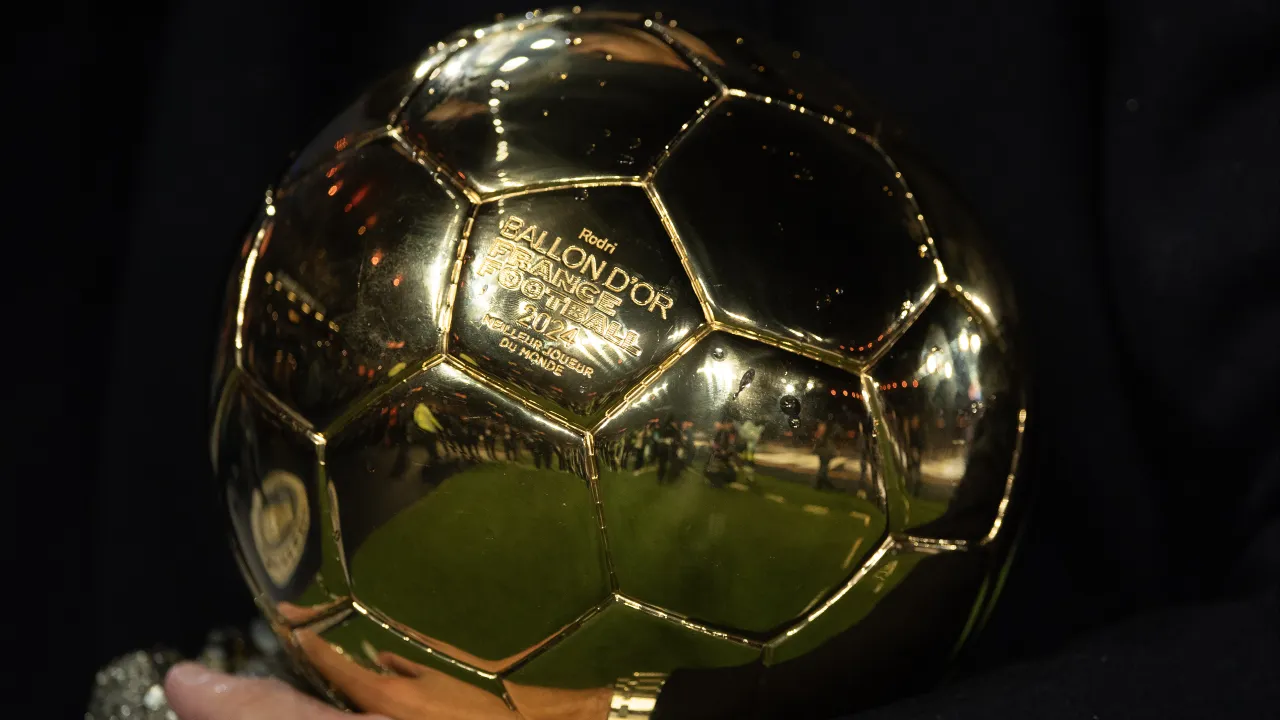
Every year, the Ballon d’Or is given out to the greatest football player from the previous season, awarded to the individual who displays the most exemplary performance across the entirety of the criteria period.
Traditionally an award for European players from European nations, the eligibility for those who can win the Ballon d’Or has been questioned in recent years, as the talent base spreads further across the globe.
Harry Kane, Lamine Yamal, and Kylian Mbappe are the frontrunners to win the 2026 Ballon d’Or, but there are nominees from all around the globe.
The Sporting News brings you an overview at who is eligible to win the Ballon d’Or, football’s most prestigious individual trophy, and what the history of the award is with regards to geography.
MORE: All 30 Ballon d’Or nominees for the 2026 award
Who is eligible to win the Ballon d’Or?
Beginning with the award’s inception in 1956, only players from European nations contracted to European clubs were eligible to win the Ballon d’Or.
However, that restrictive nature has evolved over the years to the more inclusive award seen today.
In 1995, the Ballon d’Or opened the nominee pool up to players of any nation playing for a European club. Then in 2007, all players in professional football around the world became eligible to win the award.
In practice, however, the prize still remains locked into European-based players. Those clubs are not only the most visible but also the most prestigious, and thus performance at the highest level in Europe places players on a pedestal above all others.
To date, no player contracted to a club outside of Europe has ever won the Ballon d’Or. The closest was Lionel Messi who secured the final Ballon d’Or of his career in 2023. While he accepted the award as an Inter Miami player, the voting period only considered the time during which he played his final year for Paris Saint-Germain. Thus, this does not officially count, but many still consider it as such.
MORE: All-time list of Ballon d’Or winners: Who has won the most? | Which club has the most Ballon d’Or winners?
Nominees for the 2026 Ballon d’Or
The men’s Ballon d’Or nominees for 2026 are as follows. Those playing for clubs outside Europe are italicized.
| Player | Team(s) | Career nominations |
| Jude Bellingham | Real Madrid / England | 4 |
| Pau Cubarsi | Barcelona / Spain | 1 |
| Marc Cucurella | Chelsea/Real Madrid / Spain | 1 |
| Ousmane Dembele | Paris Saint-Germain / France | 2 |
| Luis Diaz | Bayern Munich / Colombia | 2 |
| Bruno Fernandes | Manchester United / Portugal | 2 |
| Erling Haaland | Manchester City / Norway | 6 |
| Gabriel | Arsenal / Brazil | 1 |
| Harry Kane | Bayern Munich / England | 8 |
| Achraf Hakimi | Paris Saint-Germain / Morocco | 2 |
| Lamine Yamal | Barcelona / Spain | 3 |
| Khvicha Kvaratskhelia | Paris Saint-Germain / Georgia | 3 |
| Marquinhos | Paris Saint-Germain / Brazil | 2 |
| Sadio Mane | Al Nassr / Senegal | 5 |
| Lisandro Martinez | Inter Milan / Argentina | 5 |
| Kylian Mbappe | Real Madrid / France | 9 |
| Nuno Mendes | Paris Saint-Germain / Portugal | 2 |
| Lionel Messi | Inter Miami / Argentina | 17 |
| Michael Olise | Bayern Munich / France | 2 |
| Joao Neves | Paris Saint-Germain / Portugal | 2 |
| William Pacho | Paris Saint-Germain / Ecuador | 1 |
| Julian Quinones | Al-Qadsiah / Mexico | 1 |
| Declan Rice | Arsenal / England | 3 |
| Rodri | Man City/Barcelona / Spain | 3 |
| Fabian Ruiz | Paris Saint-Germain / Spain | 2 |
| Ferran Torres | Barcelona/PSG / Spain | 1 |
| William Saliba | Arsenal / France | 2 |
| Dayot Upamecano | Bayern Munich / France | 1 |
| Vinicius Junior | Real Madrid / Brazil | 5 |
| Vitinha | Paris Saint-Germain / Portugal | 3 |
The women’s Ballon d’Or nominees for 2026 are as follows. Those playing for clubs outside Europe are italicized.
| Player | Team(s) | Career nominations |
| Selma Bacha | OL Lyonnes / France | 2 |
| Barbra Banda | Orlando Pride / Zambia | 3 |
| Klara Buhl | Bayern Munich / Germany | 2 |
| Esmee Brugts | Barcelona / Netherlands | 1 |
| Mariona Caldentey | Arsenal / Spain | 3 |
| Scarlett Camberos | Club America / Mexico | 1 |
| Kerstin Casparij | Manchester City / Netherlands | 1 |
| Temwa Chawinga | Kansas City Current / Malawi | 2 |
| Cata Coll | Barcelona / Spain | 1 |
| Melchie Dumornay | OL Lyonnes / Haiti | 2 |
| Caroline Graham Hansen | Barcelona / Norway | 3 |
| Alex Greenwood | Manchester City / England | 1 |
| Patri Guijarro | Barcelona / Spain | 4 |
| Pernille Harder | Bayern Munich / Denmark | 5 |
| Yui Hasegawa | Manchester City / Japan | 3 |
| Rose Lavelle | Gotham City / USWNT | 2 |
| Mapi Leon | Barcelona/London City Lionesses / Spain | 2 |
| Lorena | Kanas City Current / Brazil | 1 |
| Melvine Malard | Manchester United/Chelsea / France | 1 |
| Manaka Matsukubo | North Carolina Courage/Chelsea / Japan | 1 |
| Ewa Pajor | Barcelona / Poland | 4 |
| Vivianne Miedema | Manchester City / Netherlands | 4 |
| Claudia Pina | Barcelona / Spain | 2 |
| Alexia Putellas | Barcelona/London City Lionesses | 5 |
| Alessia Russo | Arsenal / England | 2 |
| Momoko Tanikawa | Bayern Munich / Japan | 1 |
| Wendie Renard | OL Lyonnes / France | 6 |
| Khadija Shaw | Manchester City / Jamaica | 3 |
| Caroline Weir | Real Madrid/OL Lyonnes / Scotland | 2 |
| Tessa Wullaert | Inter Milan/Como / Belgium | 1 |
How is the Ballon d’Or decided? Explaining criteria
There are three main criteria that France Football has instructed voters to consider when crafting their list of potential winners:
- Individual performance, decisive impact, and impressive character
- Team achievements and collective success
- Sportsmanship and the player’s class, on and off the pitch
This means that not only does an individual’s raw output matter, but also how well they contribute to their team’s collective success, and the manner in which they conduct themselves.
What is NOT meant to be considered is past achievements or global status. Thus, players who have won the award before are not supposed to be given a higher platform simply because of career success beyond the indicated time period.
The Ballon d’Or, in theory, is meant simply to recognize the best player from the given time period and nothing more. That given time period has changed in recent years, however. Originally meant to produce the best player from the last calendar year, France Football recently changed the consideration timeframe to fit the European season. Thus, consideration is taken from the start of August through the end of the competitive summer tournaments.
For the 2025/26 season, that means the consideration period begins at the start of league campaigns in August 2025 and runs through the end of the 2026 FIFA World Cup.