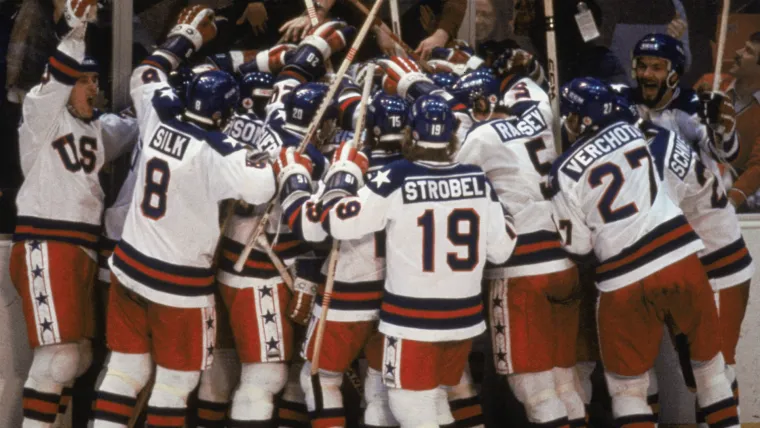
Forty-six years to the day after a group of college kids froze time in Lake Placid, the United States men’s hockey team takes the ice in Milan to face their fiercest rivals, Canada, with Olympic gold once again hanging in the balance. February 22 is a date etched into the soul of American sports, marking the anniversary of the 1980 “Miracle on Ice,” when the U.S. stunned the Soviet “Red Machine” in what remains the most legendary and improbable moment in the history of the sport.
The echoes of Al Michaels’ iconic “Do you believe in miracles?” still reverberate every time an American squad dons the red, white, and blue on the world stage. While the 1980 triumph was a story of scrappy underdogs amid Cold War tension, today’s showdown represents a fundamentally different era of American dominance.
The gap between the “Miracle” and the present day has seen the United States evolve from a hockey afterthought into a perennial powerhouse. Where Herb Brooks once had to scour college campuses for talent capable of competing with professionals, the 2026 roster is a “Who’s Who” of NHL superstardom.
Before Team USA goes for its first gold since that legendary year, let’s take a look at where the Miracle team is now.
MORE 2026 OLYMPICS: Live medal tracker | Viewer’s guide | Day-by-day schedule
Where is the ‘Miracle on Ice’ team now?
Forty-six years after the most famous whistle in sports history, the names Eruzione, Craig, and Brooks remain synonymous with American resilience. While the 1980 team has moved on to various chapters of life, their presence is felt as strongly as ever as a new generation of Americans takes the ice in Milan.
Mike Eruzione
The man who scored the game-winning goal against the Soviets, the 1980 Team USA captain never played professional hockey, famously stating he had already reached the “pinnacle.”
Eruzione serves as the Director of Special Outreach at his alma mater, Boston University, where he focuses on alumni relations and fundraising. He also continues to manage the Mike Eruzione Team Shop in Lake Placid and recently auctioned several historic items to benefit his family and non-profit foundation.
Eruzione is currently in Milan for the 2026 Winter Olympics, supporting the U.S. men’s and women’s teams. He recently expressed pride in the women’s gold medal win and is eager to see the men follow suit
MORE: Mike Eruzione talks 2026 U.S.-Canada gold medal game
Jim Craig
The backbone of the 1980 squad, Craig made 36 saves during the “Miracle” game. Following a brief NHL career with the Atlanta Flames, Boston Bruins, and Minnesota North Stars, he transitioned into a highly successful business career.
Craig is the founder and president of Gold Medal Strategies, a motivational speaking and leadership consulting firm. He leverages the lessons from 1980 to teach corporate teams about trust, accountability, and “training to win.” He has authored two books, “Gold Medal Strategies” and “We Win!,” which detail the techniques needed to build winning teams in the business world.
He also serves on the board of directors for the Special Operations Warrior Foundation.
MORE: Inside Team USA’s 2026 Olympic roster
Herb Brooks
The architect of the “Miracle,” Brooks passed away in a tragic car accident on August 11, 2003, at the age of 66. Despite his passing, his legacy is a cornerstone of American hockey culture.
Kurt Russell’s performance as Herb Brooks in Miracle is so powerful & so real, I’ve found myself turning to this monologue at some of the hardest moments of my life. I’m from the Midwest. You have no idea what this story & this film means to people. Glad the #Olympics are here. pic.twitter.com/x3gMYgcT6K
— Cinema Tweets (@CinemaTweets1) February 7, 2026
After 1980, Brooks coached multiple NHL teams and returned to the Olympic stage twice—leading France in 1998 and guiding Team USA to a silver medal in Salt Lake City in 2002.
MORE: Will injured star Sidney Crosby play for Canada vs. Team USA?
Jack O’Callahan
The fiery defenseman known as “OC” became a symbol of the team’s grit after returning from a significant knee injury just in time to play against the Soviets.
O’Callahan went on to a successful NHL career, playing primarily for the Chicago Blackhawks and later the New Jersey Devils. After retiring from hockey, he co-founded Beanpot Financial Services in Chicago, where he has spent decades as a successful businessman in the financial sector.
He remains one of the most vocal ambassadors for the 1980 team, frequently appearing at reunions and charity events.
MORE: Where Macklin Celebrini ranks among youngest Olympians ever
Rob McClanahan
Here is the star forward who famously played through a painful thigh injury during the tournament (after a legendary locker room “motivation” session from Herb Brooks).
Like O’Callahan, McClanahan transitioned into the world of finance, working as a head institutional trader for several prominent firms in Minneapolis. He recently appeared in the 2026 Netflix documentary “Miracle: The Boys of ’80, “where he reflected on how Brooks pushed the team to reach their highest level at the most critical moments.
MORE: Sporting News predictions for the USA-Canada gold medal game
Mark Johnson
While Eruzione scored the famous game-winner, many — including Eruzione himself — point to Mark Johnson as the best player on that ice. He scored two goals against the Soviets, including the crucial one at the end of the first period.
Johnson has become a legendary figure in his own right as the head coach of the University of Wisconsin women’s hockey team. He has led the Badgers to multiple NCAA championships and is the winningest coach in NCAA women’s hockey history. Two of his current players, Caroline Harvey and Laila Edwards, along with alumn Hilary Knight, took home gold in Milan.
He coached the U.S. Women’s Olympic team to a silver medal in 2010.
MORE: Updated medal count for Team USA
Buzz Schneider
The veteran of the squad, having also played in the 1976 Olympics, Schneider scored the first goal against the Soviet Union to keep the U.S. in the game early.
After hockey, Schneider returned to his roots in Minnesota, working in the real estate and insurance industries. He has been active in international hockey relations and spent time playing and coaching in Europe (Switzerland) following the 1980 win. He remains a regular at the team’s fantasy camps in Lake Placid.
MORE: Mike Eruzione talks U.S.-Canada gold medal game
Revisiting ‘Miracle on Ice’
Almost half a decade later, the “Miracle on Ice” remains the ultimate moment for American sports—not just because of the scoreboard, but because of the sheer cultural weight it carried.
In February 1980, the United States was a nation grappling with the Iran Hostage Crisis, record-high inflation, and the suffocating tension of the Cold War. When Herb Brooks’ roster of college kids took the ice against a Soviet “Red Machine” that had won four consecutive Olympic golds, it wasn’t just a hockey game; it was a David vs. Goliath narrative played out on a sheet of frozen water.
The beauty of the Miracle lies in its modern impossibility. In today’s era of 24-hour scouting and professional Olympic rosters, a group of amateur students taking down the greatest hockey dynasty in history simply wouldn’t happen. Brooks famously spent months conditioning his players to be the “fittest team in the world,” knowing they couldn’t out-skill the Soviets, but they could out-work them. That 4-3 victory in the medal round (often mistaken for the gold medal game itself) provided a rare, singular moment of national unity that still brings tears to the eyes of those who watched it live.
Today, as the U.S. faces Canada on that same anniversary, the spirit of 1980 serves as both a shadow and a spark. While the current American stars are multi-millionaire professionals rather than scruffy undergraduates, they carry the same “blue-collar” identity that Brooks instilled decades ago. The miracle proved that American hockey belonged on the world stage; now, the 2026 squad is looking to prove that they no longer need a miracle to stand at the top of the podium.
MORE: Ranking the best 11 players in the USA-Canada gold medal game
Who did the U.S. play in the ‘Miracle on Ice?’
The 1980 United States Olympic team secured their legendary victory against the Soviet Union, a squad widely considered the greatest hockey machine ever assembled.
While the 4-3 box score in Lake Placid is immortalized in sports history, the context of the Soviet roster adds a layer of depth to the “Miracle” narrative. Unlike the American team of college students, the USSR players were seasoned veterans who functioned as a professional unit in every sense but the official title. They lived and trained together nearly year-round under a state-sponsored system that prioritized international dominance as a tool of political propaganda.
A significant element of the drama surrounding that 1980 Soviet team was the fact that their elite stars were strictly forbidden from playing in the NHL. Icons like goaltender Vladislav Tretiak and defenseman Viacheslav Fetisov were arguably the best at their positions globally, yet they were trapped behind the Iron Curtain by a government that feared the symbolic blow of its athletes defecting to the capitalist West. The Soviet authorities viewed their players as soldiers of the state, and allowing them to sign professional contracts in North America was seen as an unthinkable concession to their Cold War rivals.
It was not until nearly a decade after the Lake Placid games that the geopolitical landscape shifted enough to allow these legendary players to cross the Atlantic. When the Soviet Union finally began to permit its stars to join the NHL in 1989, it signaled the end of an era of mystery and isolated dominance. This historical barrier makes the 1980 victory even more profound, as the American amateurs weren’t just playing against another team; they were facing a closed-system juggernaut that the Western professional world rarely had the chance to challenge, let alone defeat.
MORE: Inside the Hughes family tree
Who did USA beat in 1980 gold medal game?
The United States defeated Finland to win the gold medal at the 1980 Lake Placid Olympics.
While the “Miracle on Ice” victory over the Soviet Union is the most famous moment, it actually took place in the first game of the medal round. Because the tournament used a round-robin format rather than a single-elimination bracket, the U.S. still needed to win their final game to secure the gold.
In the game, the Americans trailed 2-1 going into the third. But, U.S. scored three unanswered goals in the final frame — one each from Phil Verchota, Rob McClanahan, and Mark Johnson — to win 4–2.
MORE: Inside the history of the USA-Canada hockey rivalry
1980 USA ‘Miracle on Ice’ roster
| Name | Position | College / Hometown | Post-Olympic NHL Career |
| Jim Craig | G | Boston University | Flames, Bruins, North Stars |
| Steve Janaszak | G | Univ. of Minnesota | North Stars, Rockies |
| Ken Morrow | D | Bowling Green | NY Islanders (4x Stanley Cup Winner) |
| Mike Ramsey | D | Univ. of Minnesota | Sabres, Red Wings, Sharks |
| Jack O’Callahan | D | Boston University | Blackhawks, Devils |
| Bill Baker | D | Univ. of Minnesota | Canadiens, Rockies, Blues, Rangers |
| Bob Suter | D | Univ. of Wisconsin | Drafted by Kings (Pro in CHL) |
| Dave Christian | D | Univ. of North Dakota | Jets, Capitals, Bruins, Blues, Blackhawks |
| Mike Eruzione (C) | F | Boston University | Retired after Olympics |
| Mark Johnson | F | Univ. of Wisconsin | Penguins, North Stars, Whalers, Devils |
| Neal Broten | F | Univ. of Minnesota | North Stars, Devils, Kings, Stars |
| Rob McClanahan | F | Univ. of Minnesota | Sabres, Whalers, Rangers |
| Buzz Schneider | F | Univ. of Minnesota | Played professionally in Europe |
| Mark Pavelich | F | Univ. of Minnesota-Duluth | Rangers, North Stars, Sharks |
| Dave Silk | F | Boston University | Rangers, Bruins, Red Wings, Jets |
| Steve Christoff | F | Univ. of Minnesota | North Stars, Flames, Kings |
| John Harrington | F | Univ. of Minnesota-Duluth | Professional in CHL/Europe |
| Phil Verchota | F | Univ. of Minnesota | Professional in Finland |
| Eric Strobel | F | Univ. of Minnesota | Drafted by Sabres (Pro in AHL) |
| Mark Wells | F | Bowling Green | Drafted by Canadiens (Pro in CHL) |