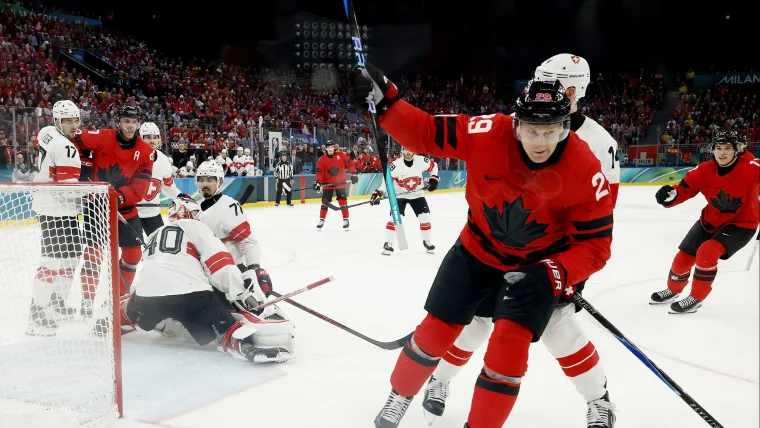
Canada and the United States have unsurprisingly been two of the most dominant teams in the preliminary round of Olympic men’s hockey in Milan, but only one can enter the tournament phase of competition as the top seed.
The race for the No. 1 seed might come down to a tiebreaker, rather than win totals. If the United States and Canada each finish with three regulation wins, figuring out who avoids the No. 2 seed will require some math.
Here’s what you need to know about Olympic hockey tiebreakers and how the No. 1 seed will be determined between the U.S. and Canada.
MORE 2026 OLYMPICS: Live medal tracker | Viewer’s guide | Day-by-day schedule
Olympic hockey tiebreakers, explained
For two teams with the same number of points in the same group, the tiebreaker is the result of their head-to-head game. Two teams in different groups, however, cannot rely on a head-to-head matchup to determine a seeding tiebreaker.
That means the No. 1 seed comes down to goal differential. Whichever team has the higher goal differential through three games will receive the No. 1 seed, while the team with the lower goal differential slips to the No. 2 seed.
If the goal differential is even, the tie would be decided by which team scored more goals, regardless of goal differential.
The complete procedure for seeding the Olympic hockey tournament can be found here.
What is goal differential?
Goal differential is simply a team’s margin of victory and margin of defeat from the preliminary round added up. For example, if a team wins its first game by three goals, then loses a game by one and wins its final game by two, its goal differential would be +4.
Canada defeated France 10-2 on Sunday, bringing their goal differential to +17 for the tournament. That means the United States would have to defeat Germany by at least 10 to secure the No. 1 seed, as the U.S. enters its final game with a goal differential of +7.
MORE: Full box score from Canada’s matchup with France
Canada hockey schedule, results
After Sunday’s game, Canada is 3-0 with a +17 goal differential.
| Date | Opponent | Result |
| Feb. 12 | Czechia | W, 5-0 |
| Feb. 13 | Switzerland | W, 5-1 |
| Feb. 15 | France | W, 10-2 |
USA hockey schedule, results
The United States entered Sunday 2-0 with a goal differential of +7.
| Date | Opponent | Result |
| Feb. 12 | Latvia | W, 5-1 |
| Feb. 14 | Denmark | W, 6-3 |
| Feb. 15 | Germany | TBD |
MORE: 2026 Olympic hockey top goal scorers
Who is the No. 1 seed in Olympic hockey bracket?
The No. 1 seed has yet to be determined, but Canada entered Sunday with a two-goal advantage in goal differential and improved its chances at the No. 1 seed by defeating France 10-2. Unless the USA defeats Germany by at least 10 goals, Canada will be the top seed.
The No. 1 seed could be an especially massive advantage in this year’s tournament, as the No. 2 seed has a strong chance to face Sweden in the quarterfinals. While both Canada and the U.S. feel they can win against anyone in the tournament, Sweden is uncharacteristically talented for a potential No. 7 and wouldn’t be an easy out.
MORE: Ranking the 23 best NHL players in the 2026 Olympics
Olympic hockey bracket
Here’s a look at the projected Olympic hockey bracket before the USA’s game against Germany on Sunday.
- Canada (qualified for quarterfinals)
- United States
- Slovakia (qualified for quarterfinals)
- Finland
- Switzerland
- Latvia
- Sweden
- Czechia
- Germany
- Denmark
- France
- Italy
All 12 teams advance past the preliminary round, but every team outside the top four seeds must play a playoff game to qualify for the quarterfinals. The top four seeds will automatically advance to the quarterfinals.